
404 U.S. facilities turn food waste into biogas for renewable energy today. Capturing energy from more discarded food could meet the energy needs of 1.5 million additional households.
WASHINGTON – November 5, 2026 – As Americans prepare Thanksgiving meals, stock their refrigerators and eventually clear their plates, much of the food that goes uneaten will end up discarded. But food that can’t be eaten doesn’t have to go to waste entirely. Across the country, biogas capture facilities are recycling discarded food into renewable energy ─ and new research from the American Biogas Council (ABC) finds that the opportunity to do more is enormous.
Food waste naturally produces biogas when the microorganisms in it break down the organic material. Biogas systems capture all the biogas to keep it from going into the air and use it to generate renewable electricity and heat, or be processed into renewable natural gas (RNG).
ABC’s research team reports 404 operating facilities across 48 states that produce biogas from food waste. About 200 of these facilities operate at farms and wastewater treatment plants and combine food waste with manure or wastewater to capture biogas. Another 20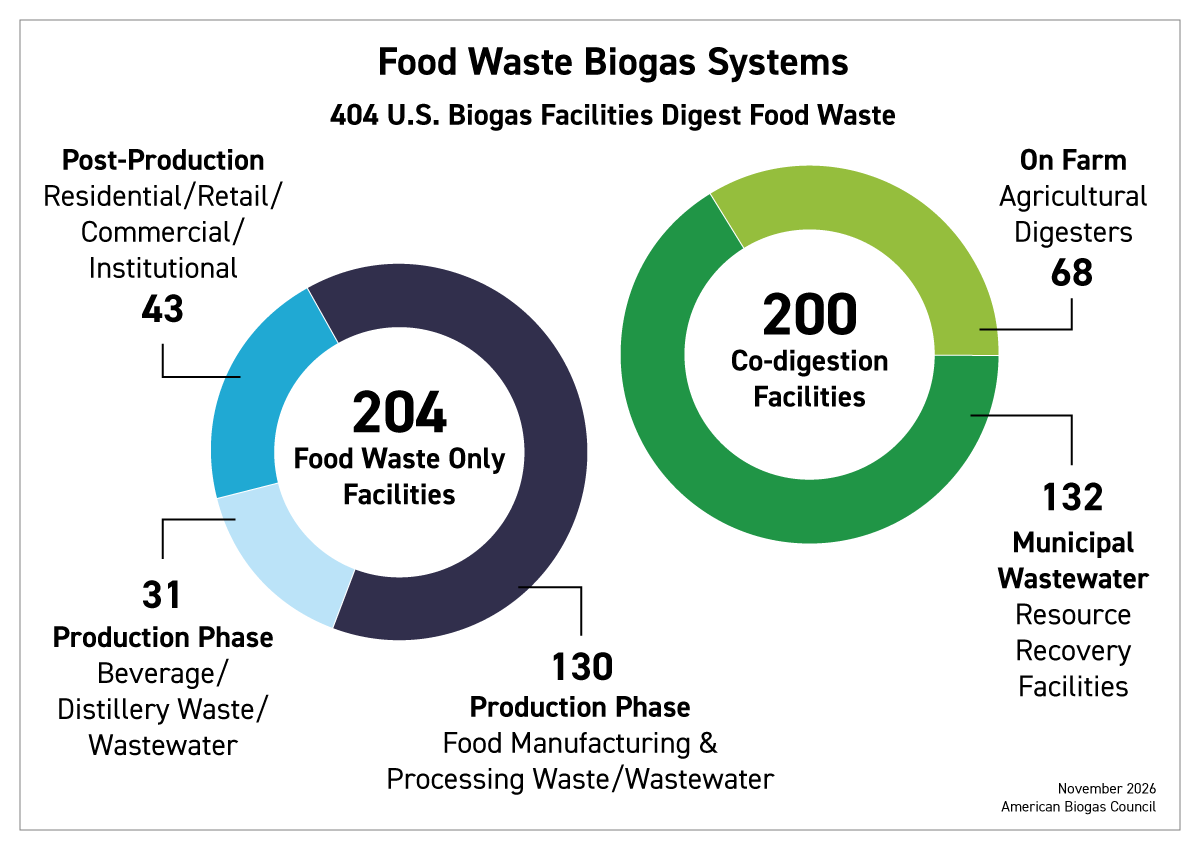 4 facilities make use of food waste alone, capturing approximately 36 billion cubic feet of biogas annually, and representing nearly $3 billion in capital investment.
ABC’s expanded research this year uncovered projects not previously included in its inventory. The increase of 73% over last year’s count reflects a more complete picture of the industry.
“America is literally throwing away enough renewable energy to power millions of homes,” said Patrick Serfass, Executive Director of the American Biogas Council. “The technology to make energy from food waste is already operating, but the potential to turn more of what we routinely discard into a valuable domestic energy resource is enormous.”
Food waste is already producing energy across America
The facilities identified by ABC handle food waste from food manufacturers, grocery stores, restaurants and other sources. Some capture energy from food and beverage manufacturing. Others process retail food waste, including food that spoils, is rejected or remains unsold.
Of the 204 food-waste-only facilities, 161 process pre-consumer food waste, primarily wastewater from food processing and beverage manufacturing. Another 43 facilities handle retail food waste, capturing approximately 8.2 billion cubic feet of biogas annually.
Most facilities use their biogas to generate electricity and heat. In fact, 164 food-waste-only facilities produce power, heat or both. Another 38 upgrade biogas into RNG.
A growing industry, with bigger projects and more investment
Food-waste biogas projects are getting larger and attracting more investment. The 42 facilities that have come online since 2020 account for 32% of the sector’s annual biogas production and 45% of its total investment. On average, these newer projects capture nearly twice as much biogas as earlier projects and cost about three times as much to build.
The momentum continued in 2025, when seven new food-waste projects came online, all of which produce RNG. Together, they added more than twice the biogas capture capacity of any other year since 2020.
The opportunity: Five times more biogas
The potential to expand food-waste energy recovery is substantial. ABC estimates that if all 70 million tons of discarded food generated in the United States in 2024 were processed through anaerobic digestion, it could produce approximately 181 billion cubic feet of additional biogas annually—roughly five times the amount currently captured by the country’s dedicated food-waste biogas facilities.
That additional biogas represents approximately 113 million MMBtu of energy, enough to meet the annual energy needs of approximately 1.5 million U.S. households.
This holiday season, as Americans think about what happens to the food left behind, there’s another part of the story worth knowing: some of it can help produce the energy we use every day.
Explore the ABC’s Food Waste Fast Facts, additional graphs, biogas project profiles, and more in the American Biogas Council Newsroom.
# # #
About the American Biogas Council
The American Biogas Council is the voice of the U.S. biogas industry, representing all companies working to recycle organic waste into clean, locally made energy and fertilizer. Biogas capture systems recycle waste, food scraps, manure, and wastewater, keeping communities safe and clean, and supporting local economies. The ABC’s mission is to maximize the economic and environmental benefits of biogas while advancing sustainable solutions for energy, agriculture, and waste management. Learn more at AmericanBiogasCouncil.org, on X @ambiogascouncil, Facebook, and LinkedIn.