New Data Shows Landfill Gas Projects Now Account for 64% of U.S. RNG Production, with More than 700 Additional Facilities Suitable for Development
WASHINGTON– July 7, 2026 – Landfills are the largest source of captured biogas in the U.S., driving record investment in renewable natural gas (RNG) production, according to new data released today by the American Biogas Council (ABC). The nation’s 598 landfill gas capture systems provide about three-quarters of all biogas captured in the U.S. and produce 64% of the nation’s RNG.
Developers brought 20 new landfill gas projects online in 2025, all of which capture additional biogas and convert it into RNG that displaces conventional natural gas. Together, these facilities added 39.9 billion cubic feet (Bcf) new biogas capture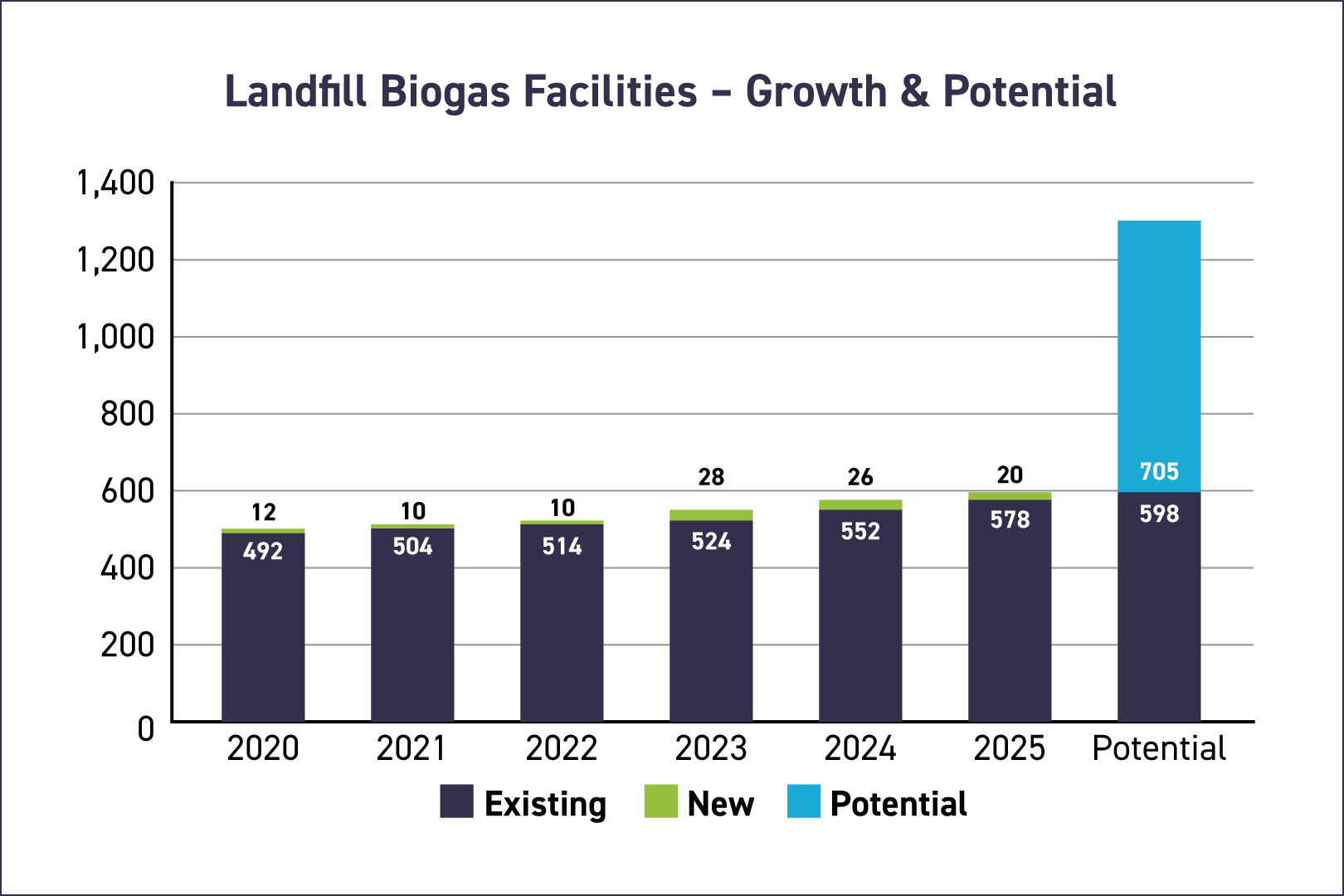 capacity – about 75% of all new U.S. biogas capture capacity added last year across all biogas sectors.
Although landfill gas systems represent fewer than one-quarter of the nation’s 2,580 operating biogas facilities, they account for approximately three-quarters of all biogas captured for energy. Landfill gas facilities typically capture far larger volumes of biogas than systems in the agriculture, wastewater, or food waste sectors, resulting in a disproportionate share of total biogas capture.
“Landfill gas projects are proof that America can produce more energy by using resources we already have,” said ABC’s Executive Director Patrick Serfass. “By capturing biogas that would otherwise be released or flared, these facilities create fuel and electricity while delivering economic value to communities across the country.”
Biogas is produced when organic material – such as food waste, manure and wastewater sludge – breaks down without oxygen. At landfills, that gas can be captured instead of being released or flared and used to generate electricity and heat or converted into renewable natural gas (RNG) that can be delivered through existing pipelines.
Among the report’s key findings:
- More than 559 billion cubic feet (Bcf) of landfill gas is now captured annually across the U.S.
- Since the end of 2020, 93 new landfill gas projects have come online, an 18.4% increase. All but nine of these newest facilities produce RNG.
- Landfill-derived RNG supplies approximately 143.7 million MMBtu annually.
- Total estimated investment in landfill gas facilities has reached nearly $14.9 billion, including nearly $1 billion invested in projects entering service during 2025.
- All landfill gas facilities capture enough energy to meet the annual needs of nearly 3.9 million U.S. households.
Although RNG development at landfills has expanded rapidly, electricity generation remains a major use of landfill gas. Nearly three-quarters (73%) of all landfill gas facilities nationwide continue to generate electricity or produce thermal energy, accounting for over half of all biogas captured.
The report also identifies substantial opportunities for future growth. Based on the U.S. EPA Landfill Methane Outreach Program classifications, approximately 705 additional landfills remain suitable for landfill gas development. This includes projects currently under construction, in planning, or identified as future candidates.
ABC estimates these untapped sites could provide as much as 455 billion cubic feet of additional biogas annually, representing one of America’s largest remaining opportunities to capture wasted biogas, expand domestic renewable energy production, and reduce methane emissions.
The findings are based on the American Biogas Council’s Biogas Projects Database, the nation’s most comprehensive database of U.S. biogas facilities.
To learn more about the U.S. biogas industry, view state-level data, or download the complete Biogas in America 2026 report, visit https://americanbiogascouncil.org/biogas-market-data/.
About the American Biogas Council
The American Biogas Council is the voice of the U.S. biogas industry, representing all companies working to recycle organic waste into clean, locally made energy and fertilizer. Biogas capture systems recycle waste, food scraps, manure, and wastewater, keeping communities safe and clean, and supporting local economies. The ABC’s mission is to maximize the economic and environmental benefits of biogas while advancing sustainable solutions for energy, agriculture, and waste management. Learn more at americanbiogascouncil.org, on X @ambiogascouncil, Facebook, and LinkedIn.